

Editorial Governance
Understand how Eclipse uses E-E-A-T scoring, source trails, justifications, and approval gates before content goes live.
Editorial governance in Eclipse is the quality layer between a generated draft and a published article. It is how the platform checks that a standard article is grounded, reviewable, and ready for human approval before it reaches your workspace.
What governance means in Eclipse
For standard articles, Eclipse does not stop at generation.
It also gives you the controls to review:
-
how well the article meets E-E-A-T standards
-
whether claims are supported by traceable sources
-
why specific wording, structure, and citations were used
-
whether the article is ready for a human sign-off
That is why the workflow ends in review, not blind publish.
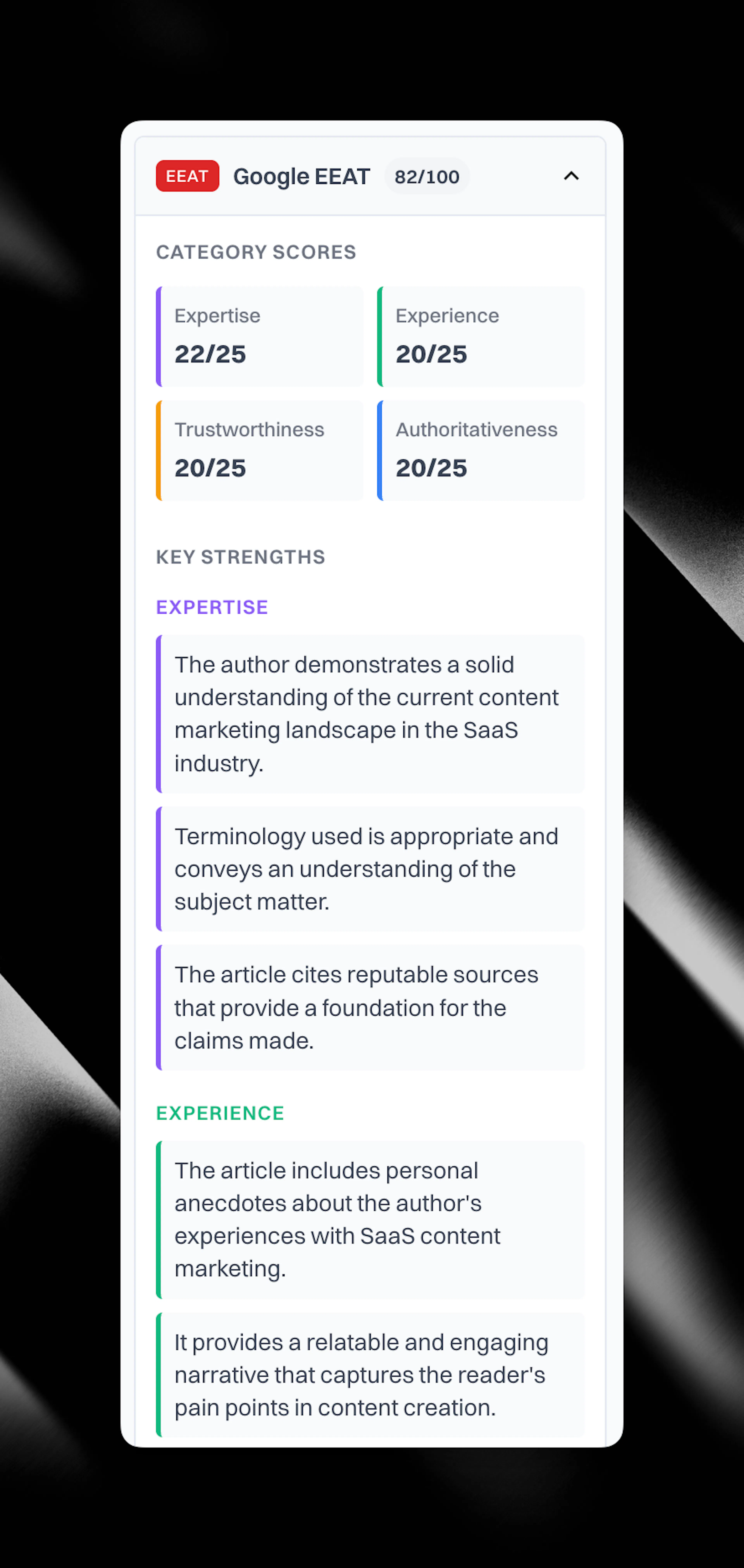
The E-E-A-T score on standard articles
For non-Medium articles, the content table shows an E-E-A-T score on the article row.
That score gives you a quick read on how the draft performs as a standard article before you open it. It helps you decide which drafts are closest to approval and which ones need a closer look.
What the governance layer includes
Eclipse uses several connected checks when you review a standard article.
Source trail. Citations and references trace back to the material behind the draft, including canvas nodes, connected documents, and external sources gathered during research.
Justifications. The editor's justification panel explains why titles, claims, citations, structure, audience targeting, and brand-language decisions were made. See Justifications.
Approval gate. Nothing publishes without your sign-off. Human approval is the final step between the draft and the live page.
Author and brand controls. Brand rules, banned terms, citation standards, structure preferences, and author details all shape the article before it reaches review.
What the review gate helps you catch
Governance is there to stop weak content before it goes live.
It helps you catch things like:
-
unsupported numbers or claims
-
citations that need closer checking
-
wording that does not fit your brand or audience
-
structural choices that do not fit the reader journey
-
articles that need a stronger evidence trail before approval
The point is simple: you should be deciding whether the article is right, not guessing whether it is defensible.
Named authorship and accountability
Standard articles can be attributed to a named author with the profile details you set in Eclipse.
That supports clearer authorship than anonymous publishing and makes review more accountable inside the workflow.
How governance connects to Justifications
The E-E-A-T score is the quick signal. The Justifications panel is the detailed explanation.
When you open a standard article in the editor, the panel shows the full analysis for that draft. You can expand a justification, inspect why the decision was made, and see the matching section highlighted in the article.
Use the score to prioritise. Use the justifications to inspect the reasoning.
Standard articles vs thought leadership articles
This governance model applies to standard articles.
Thought leadership and Medium-style articles use a different scoring model. They do not show the same E-E-A-T score or per-article justification system as standard articles. See Thought Leadership & Medium.
How teams use editorial governance
Most teams use the governance layer the same way:
-
Review the E-E-A-T score in the content table.
-
Open the draft in the editor.
-
Check the justification panel and source trail.
-
Edit or ask CASi for clarification where needed.
-
Approve and publish when the article holds up.
That keeps the final decision with the human reviewer while giving them far more evidence than a normal AI draft.